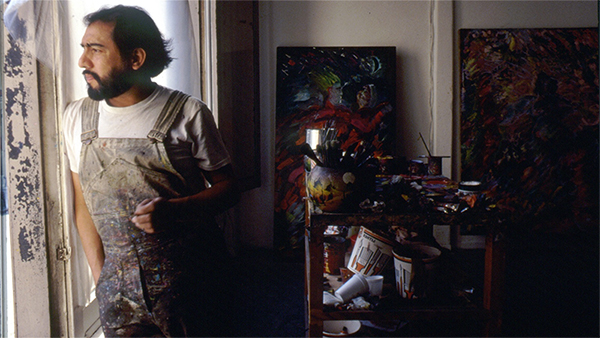
A painting he made of North Broadway had already gone out of date — Chinatown looked different now. That, he said, was exactly the point. “It makes time stand still.”
The gorilla in the church
He was four or five. His mother took him to the great cathedral on the Zócalo, and he would start crying before they got there. She kept asking why.
“There's a gorilla at church, and I don't want to see it.”
There was no gorilla. High on the far wall hung a painting of John the Baptist — draped in furs, long beard, heavy brows, covered head to foot in hair. To a small boy, unmistakably an ape. He went back as a grown man to check. It was still there.
He kept the story his whole life because of what it taught him. His first encounter with art was both horrifying and absolutely magical — proof, he said, that a painting could be something almost alive.
His first mural, painted in third grade with a classmate, was a forest of beavers and minks. A mural made entirely of fur. When his interviewer pointed it out forty years later, he laughed — he had never once connected the two.
He kept becoming himself
Elsa saw the pattern only after he was gone: Carlos reinvented himself every seven years. He would go all the way through one thing, then begin another. Each chapter a different man, the same blazing spirit.
Chicago, and the road west
Born in Mexico City, raised in a Chicago where every block held every nationality at once. At nine his father sent the family west ahead of him. Carlos translated for his mother the whole way — and they arrived in Los Angeles having lost the only phone number they had. A stranger on the street took them in.
Learning to see
East L.A., Garfield High, and a teacher named David Ramirez who ran life drawing with the discipline of a conservatory. Carlos followed him three years and then to community college. Before that, art class came on Fridays — or when it rained.
New York, in the wrong skin
Five years testing himself in the art capital, trying to become a New York minimalist. In Elsa's words it was killing his spirit: he had been born with his own images and was painting somebody else's.
The bottom, and the turn
Pancreatitis, a near-death experience at General Hospital, a life that had come apart. He came out of it certain about what was precious — and started teaching children in Lincoln Park for free. Art with no product, only process. It gave him a reason to be alive.
The movement
César Chávez and the farmworkers' causa. His first mural paid nothing at all. Then Los Four — and the first exhibition of Chicano artists at the Los Angeles County Museum of Art. Around him, always, collectives and publications and people.
Back to the studio
After a three-story mural and too many near-falls from scaffolding, he walked away from the movement's public work and turned inward. Echo Park, the crashes, the spirit-animals. Fifteen years that became the body of work the world remembers.
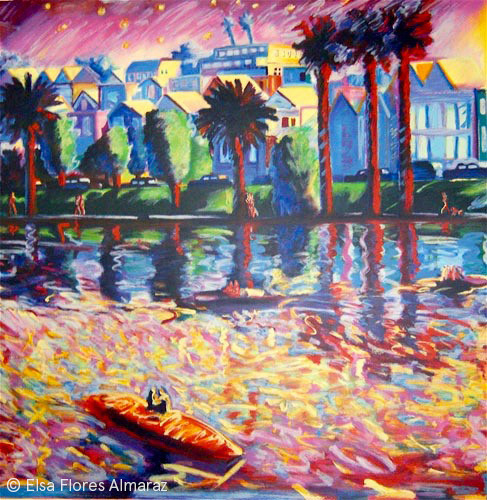
“Los Angeles presently is a romantic environment. It may not be in 50 years.”
Title, date and medium to be confirmed with the estate
He said it in 1986. When he stepped off the train in 1949 there was no freeway, no smog, no high-rise — the mountains behind Pasadena stood sharp and clear, Hollywood was a small town. He dreamed about that arrival for the rest of his life.
He tied his city paintings to the Impressionists: Paris and London turning industrial, and painters answering with a softness. Los Angeles was a metropolis with nature still creeping through it. He was not being nostalgic. He was recording something he could feel disappearing.
The lake in front, the freeway to the left
Title, date and medium to be confirmed with the estate
Two accounts survive of how these began, and both are true.
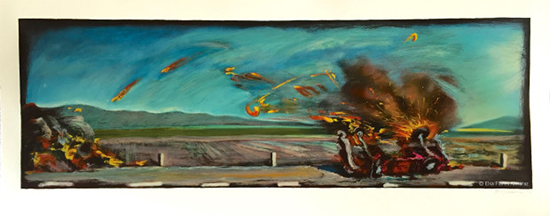
His. From the Echo Park apartment there was a serene lake in front of him and, off to the left, the Hollywood freeway — where, he said, there is a crash every few hours. He used to wake to the sound of metal crunching, and it took him weeks of living there to work out what the sound was. What held him was the contrast: the tranquility of that almost dead lake, and the violence going on just south of it. He chose to live inside that reality because it felt familiar.
Hers. Around the time they began seeing each other, Carlos's car — parked on Echo Park Avenue — was destroyed by a driver who ploughed into it. In the same stretch of months he started seeing cars colliding in his mind. Not memories; images that arrived on their own. He told his psychiatrist, and the advice came back in two parts: stop driving — take the bus, ask a friend — and paint it out.
“Just paint it out. It's just anxiety.”
So the window gave him the subject and the fear gave him the urgency. It also explains the title he chose for his 1986 show at Otis/Parsons — “L.A. Parks and Wrecks.” The parks and the wreckage were never two bodies of work. They were one view, out of one window.
Elsa became the driver. She stayed the driver after they married; he grew to like being chauffeured. Her verdict, told with a laugh thirteen years later: he painted car crashes, so she felt safer behind the wheel.
Thirty sheets of paper, rubbed black
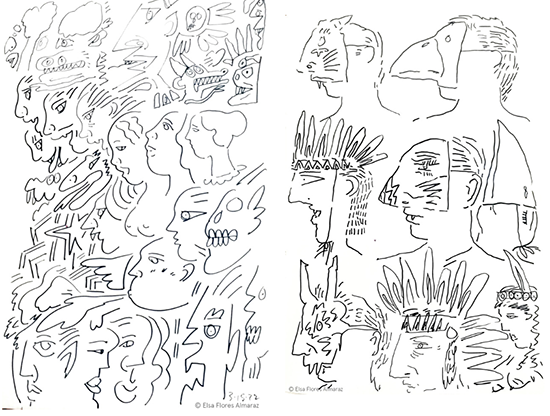
Before the murals, before Elsa, before any of the work anyone knows, there was a stretch he described plainly: his life had become a mess, his art had hit a dead end, and he had nothing left to draw.
So he took sheets of paper about thirty by forty inches, and a chunk of graphite, and rubbed. Not drawing. Darkening. From white to as close to black as he could get. Each one took hours. He made about thirty.
He knew how it sounded. Why would anyone want to turn a white piece of paper black? His answer came as an image: the graffiti scratched into the wall of some abandoned restroom, the foul words and the phone numbers. He read it as the record of people in desperate situations trying to reach out somehow. Trying to connect.
He had no reason left to draw, and something in him kept marking the paper anyway. He called that the very essence of him. The drawings went into a portfolio. He thought there might be no more art in him after that.
Title, date and medium to be confirmed with the estate
Illness, then recovery, then a park full of children he taught for nothing. Elsa's reading of the whole arc: hitting those dark places and coming out alive is what made him strong, and showed him what was precious.
Spirits, gardens, and the night city
Alongside the wrecks he painted a world of masks, jaguars, doves, dancers and blooming light — the tender, mystical register that friends said was the truest picture of him.
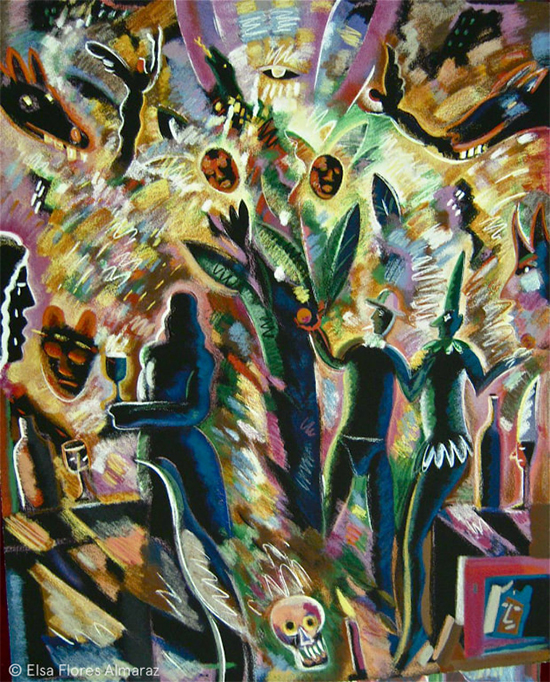
Title, date and medium to be confirmed with the estate
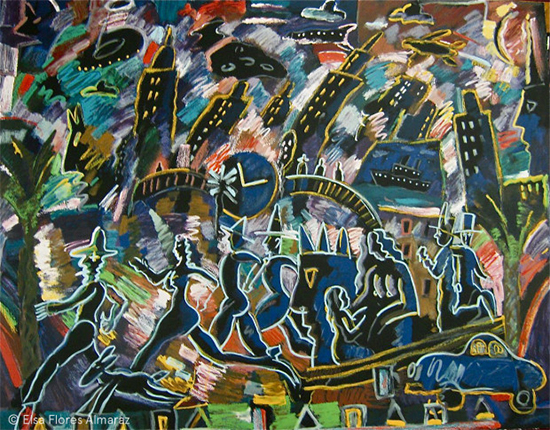
Title, date and medium to be confirmed with the estate
“I really want to start getting labeled as an international artist rather than a Los Angeles artist.”
He said it in 1987, two years before he died, and immediately admitted the tension: I am an Angelino; this is where I live. He wanted out of the regional label the way Diebenkorn wanted out of the West Coast one — without disowning a thing.
He framed it as a translation problem. Posada speaks to Latin America; Picasso speaks to a larger audience — but they are not saying the same thing. Crossing over means editing, and he knew exactly what it costs. He also insisted that not every artist should want to.
A painter who married a painter
She thought he was too old. Her mother, dropping her at the studio, looked up at Carlos watching the street from his window and delivered the verdict that decided it: “Oh, son los mejores.”
Their first date was The Black Stallion. What she remembers is not the film — it is that during the opening sequence they flinched at the same images at the same instant and squeezed each other's hand. Two painters recognising each other.
The first thing she ever bought from him was a small oil of a couple on a tropical beach. He wanted seventy-five dollars. She had twenty. He took it — most women, he said, just asked him to gift them a painting. Years later she called it a destiny piece: it had turned out to be a picture of their life. They married, and their daughter Maya was born.
She learned color from him — her scholarship had run out before the color class, and living beside a master colorist was, in her words, a major gift. He learned surface from her: how to lay paint on thick and work it. He would watch her do it, go to his own canvas, then call her over to say she should do it more like this. He was always the teacher.
People walk in and often say, “This looks like the work of a man.” She paints with a broom.
Why can't you say, “Elsa's a great painter. Look at her work”?
His reason was that it would be a conflict of interest. Hers was that they had been peers before they were married. Looking back eight years after his death she held both truths at once: it made her furious, and it turned out to be a blessing — because she was never filed away as a Hispanic artist, and could stand as an American one.
He was a fanatic for old Hollywood musicals. When her work started getting noticed he admitted — through a gag about the husband in A Star Is Born, forever being addressed as “Mr. Lester” — that he was not sure he could handle her being more successful than him. Which, as she pointed out, was never going to happen anyway. He was decades ahead of her in a career. The thought alone unsettled him.
In 2019 she gave the pattern a name: “The K Complex” — women artists eclipsed by famous husbands. She has said she regrets not getting it into the documentary. She had already described the whole thing, in detail, twenty-two years earlier.
When the commission they won together for the Ronald Reagan State Building finally came through, the canvas was stretched and the studies were done and Carlos was close to death. Ten feet by seventy. She finished it alone, inside the grief, raising Maya.
The journals
He filled sketchbooks and journals for most of his adult life — dreams, poetry, philosophy, studies for paintings, and long reckonings with everything dark he was moving through.
They survive because both of them made sure they would. Carlos gave several volumes to the Archives of American Art himself, in 1986, while he was alive. Elsa lent the rest — seventy-eight of them — to be microfilmed in 1991, and donated the remainder.
Her own comparison, made with a laugh: she writes when she is depressed and has only a few volumes. He had many more, for many more years.
Asked at the end of two years of interviews what it had been like, he said it was good to have it all in one place — “it makes me understand myself.”
He had almost died once already, twenty years before, and remembered it as beautiful. “I'm not afraid of death.”
He believed he had done everything he set out to do. The only thing that frightened him was leaving Elsa and Maya alone.
His ashes went to Kauai, to a cemetery above the ocean, beside Elsa's mother. On the headstone he is swimming — snorkel mask on.
He thrust it into the future. Someone came, and asked what in the world this was.
See him for yourself
Carlos Almaraz: Playing with Fire
His own voice, in full